
Water Saving Tips and Restrictions
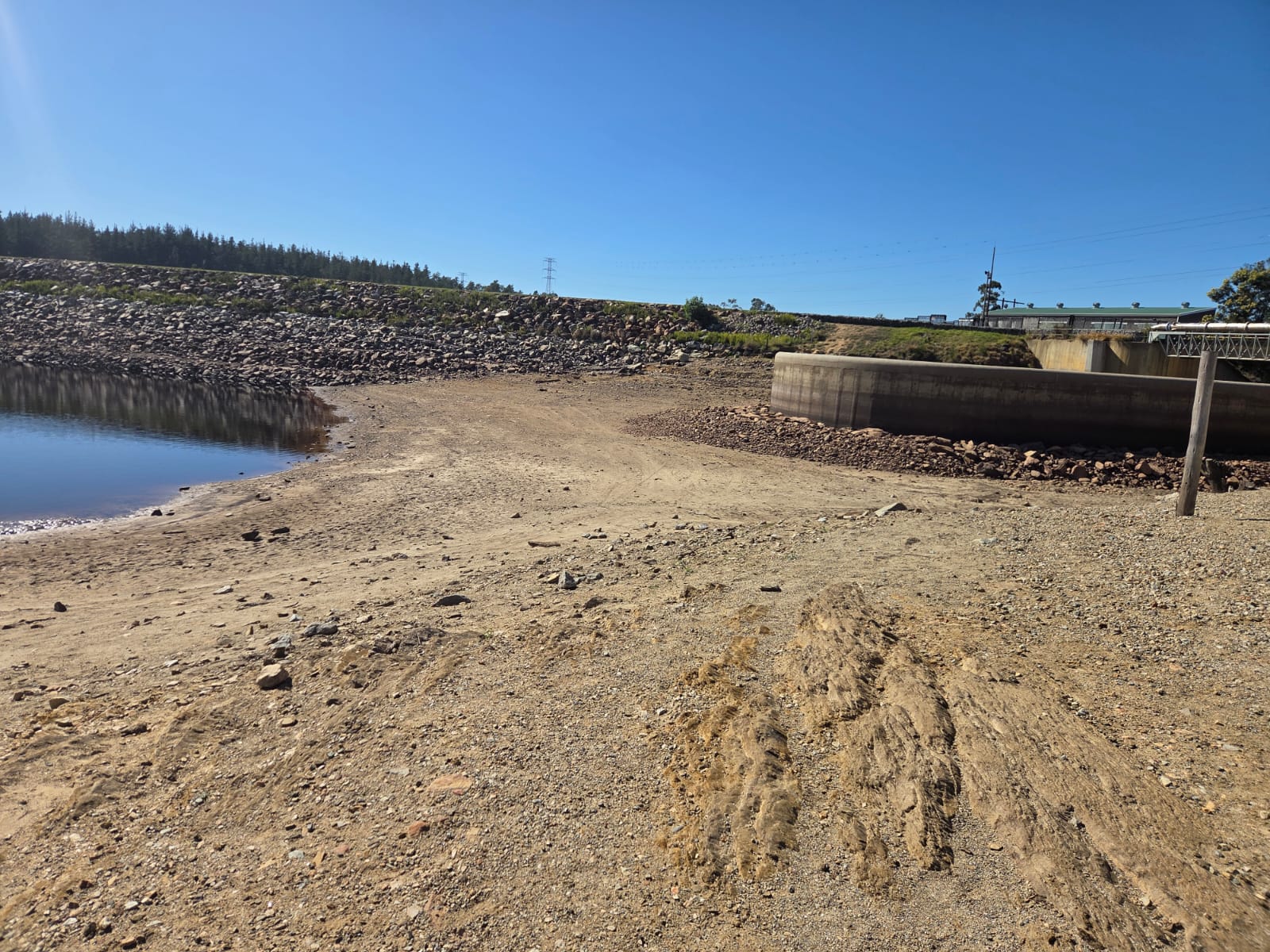
2 D Water Demand Management Measures/Water Restrictions are applicable in George and surrounds (including Uniondale and Haarlem) as of 5 January 2026.
To download Water Demand Management Measures/Water Restrictions, click the following links:
- All three languages: https://www.george.gov.za/george-document/water-demand-management-measures-2d-all-three-languages/
- English: https://www.george.gov.za/george-document/water-demand-management-measures-2d-english/
- Afrikaans: https://www.george.gov.za/george-document/water-demand-management-measures-2d-afrikaans/
- IsiXhosa: https://www.george.gov.za/george-document/water-demand-management-measures-2d-isixhosa/
Under Level 2D, all Level 2B measures remain in force, with the following additional mandatory reductions and prohibitions:
- Emergency water tariffs have come into effect following the Public Participation process which concluded on 19 December 2025.
- Households are limited to 10kl per month.
- Businesses and entertainment facilities must reduce water consumption by 25%, while industries must reduce usage by 15%, measured against applicable historical averages.
- Gardens may only be watered with watering cans or buckets, any time of the day.
- Irrigation/watering of ALL sportfields using municipal water is prohibited.
- Washing of vehicles with a garden hose using municipal water is prohibited. Buckets are allowed.
- Cleaning of any outside surface areas using a watering hose municipal water is prohibited.
- Filling up of any swimming pools or similar facility used for recreational or other purspose, with municipal water is prohibited.
- Where own water from a borehole, water tank etc. is used, “OWN WATER” signage must be displayed.
- Emergency tariffs will be implemented as per Level 3 of the 2025/2026 Tariff list.
- Flow-reducing devices shall be installed where limits are exceeded.
- Contraventions are liable to a fine or six months’ imprisonment.
- The use of hoses or other devices by all car wash businesses is prohibited. Vehicles shall only be washed using buckets, unless water is supplied from an alternate source than municipal water.
In terms of Section 5 of the By-law, residents may apply in writing for exemption from specific restrictions. No potable water may be used for construction. Contractors may apply to the Civil Engineering Services Directorate to collect treated effluent from the Gwaiing Wastewater Treatment Works. A raw water supply point at the Wilderness Water Treatment Works (WTW) is planned, and the public will be notified once this has been implemented.
Application forms for exemption can be downloaded here:
- English: https://www.george.gov.za/wp-content/uploads/2025/12/Water-Restriction-exemption-form_Dec-2025_ENGLISH.pdf
- Afrikaans: https://www.george.gov.za/wp-content/uploads/2025/12/Water-Restriction-exemption-form_Dec-2025_AFRIKAANS.pdf
- IsiXhosa: https://www.george.gov.za/wp-content/uploads/2025/12/Water-Restriction-exemption-form_Dec-2025_ISIXHOSA.pdf
These restrictions currently apply to Greater George including Uniondale or Haarlem.
Link to TARIFF DOCUMENT 2025/26 (See Page 36)
Report contraventions of the current Water Restrictions on 044 801 6350/89 – fines apply.
Report all water leaks on 044 801 9262/66 or A/ h 044 801 6300, at your nearest Area Office or Thusong Centre or email to gmun@george.gov.za or log via the My Smart City App.
Frequently Asked Questions (FAQ) on the Water Conservation Campaign
George Municipality has published a comprehensive Frequently Asked Questions (FAQ) document as part of its ongoing Water Conservation Campaign. Residents, businesses, media, and stakeholders are encouraged to read the full FAQ here:
https://www.george.gov.za/george-document/gm-water-conservation-frequently-asked-questions-february-2026/
Guidelines for Rainwater Harvesting Tanks_ Key points for property owners
- Planning approval is not immediately required to install a rainwater harvesting tank, unless the tank is positioned within the building line and exceeds the height of the boundary wall.
- Rainwater harvesting tanks are classified as Minor Building Works and require a simplified application through the Building Control Office.
- Application forms are available at: https://tinyurl.com/3f5p6phk
- Clear guidelines are available from the Building Control Office to assist residents with correct placement and the application process.
- Application fees are currently waived to encourage residents to install rainwater harvesting tanks.
- All plans for new buildings must include a 5 000ℓ rainwater harvesting tank (or a minimum of 2 500ℓ where site constraints apply).
- No exemption from the National Building Regulations can be granted. However, penalties for late applications will be waived where tanks were installed prior to approval. Please note that installation remains at the owner’s risk until formal approval has been granted.
Contact the Building Control Office:
📞 044 801 9370 / 044 801 9166 / 044 801 9019
✉️ mdyakop@george.gov.za | pmlingani@george.gov.za | smoshani@george.gov.za
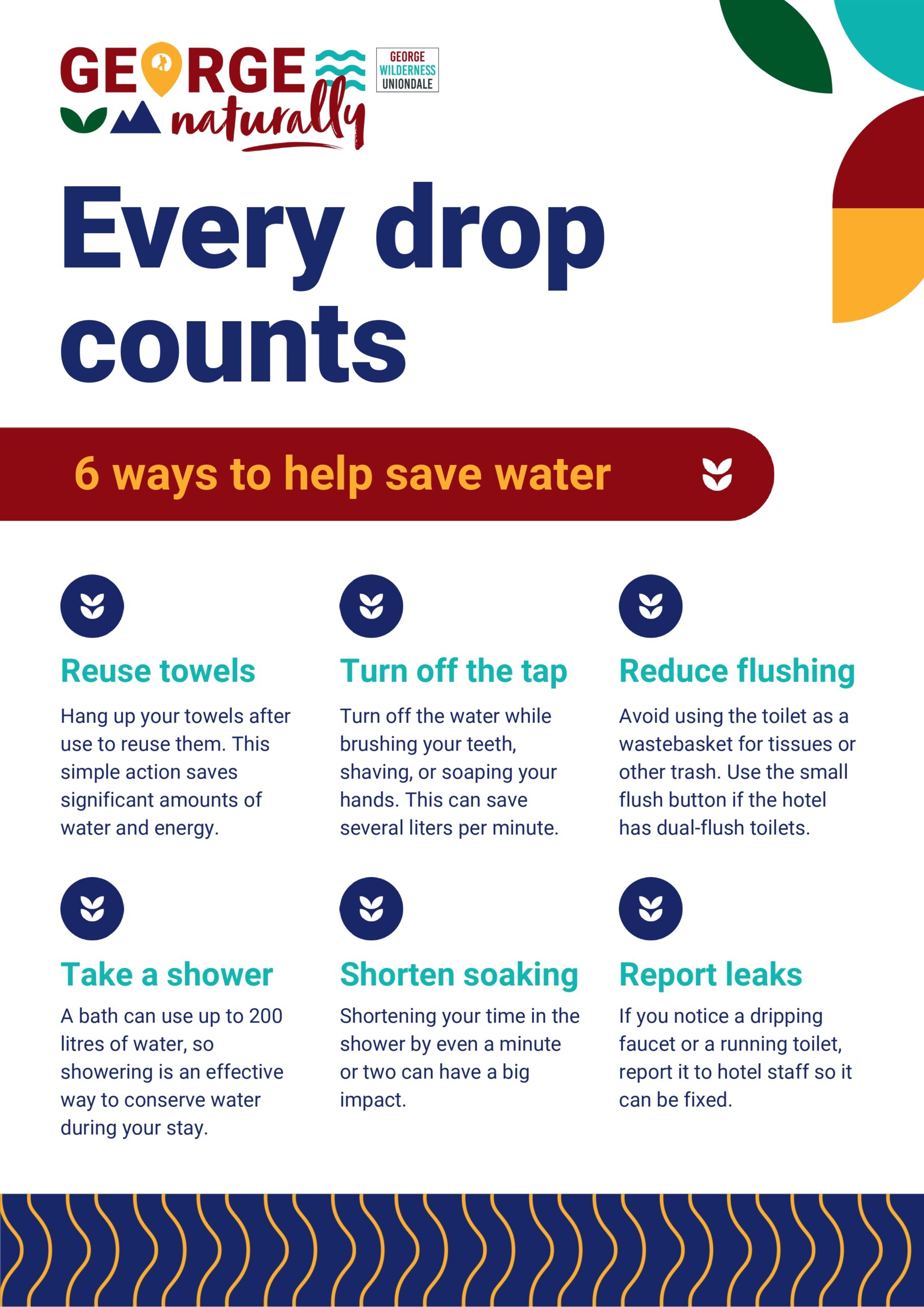
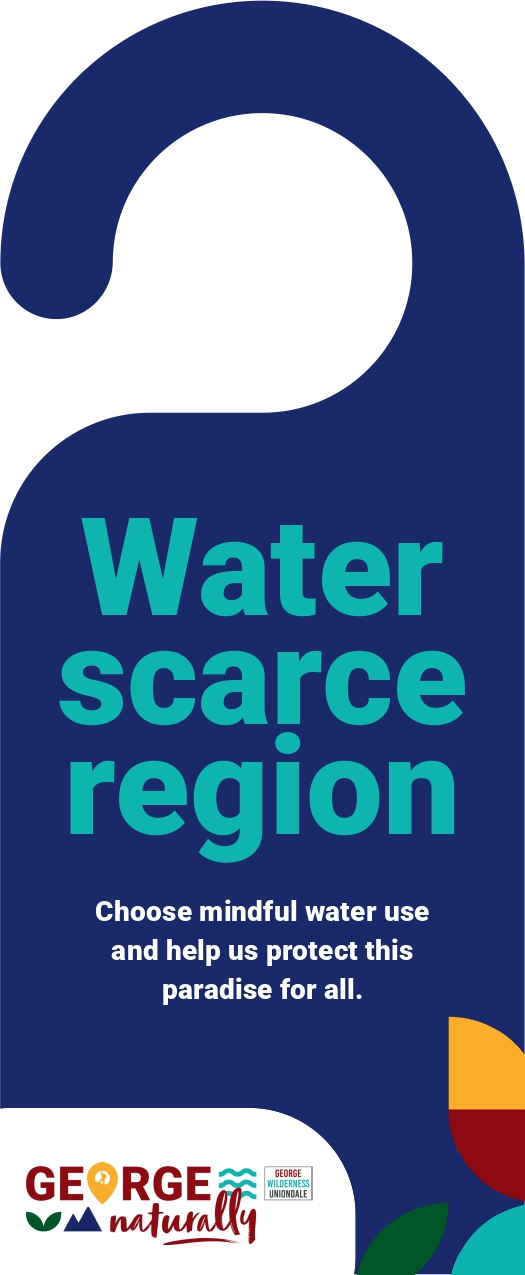
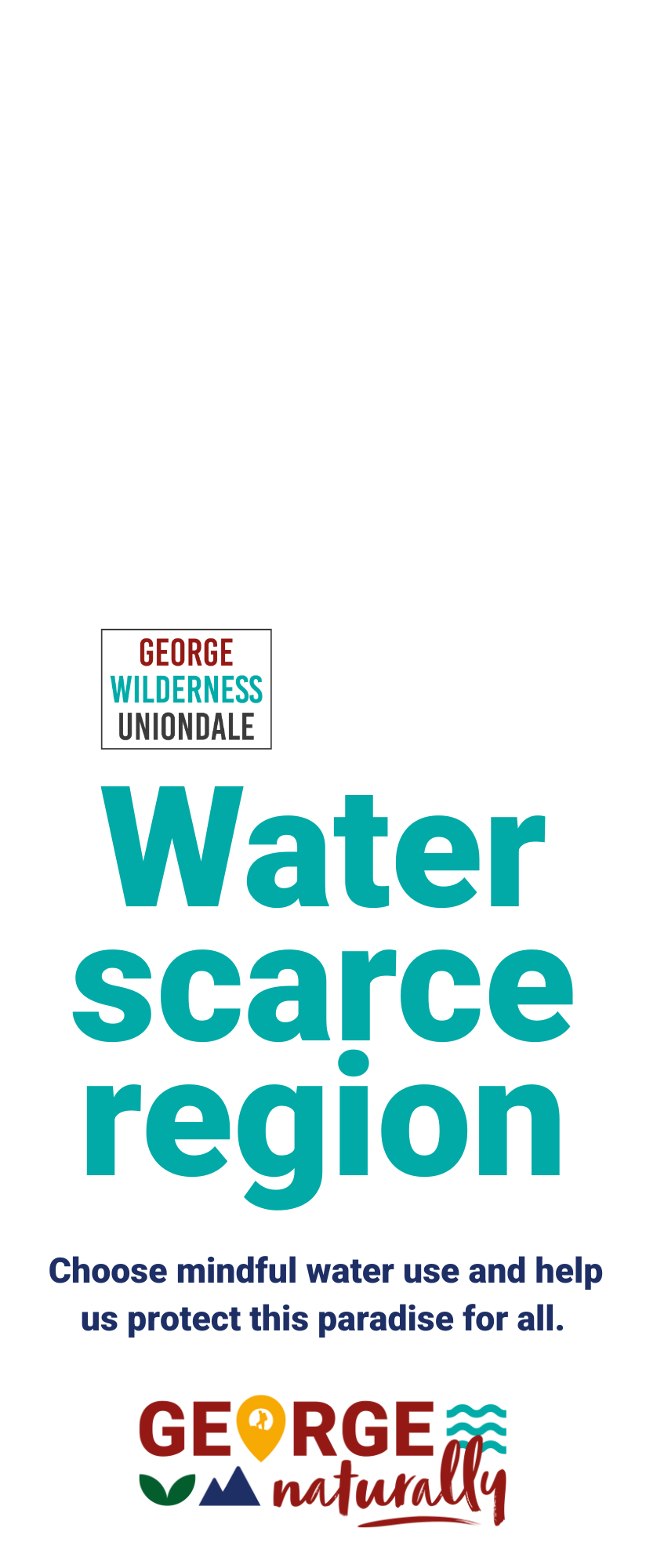
NEED WATER SCARCE AWARENESS ARTWORK FOR YOUR BUSINESS – Follow this link for downloadable material
Steps to check for leaks on the property:
- Step 1: Stop all water use. Close all the taps on the property and do not flush the toilet.
- Step 2: Check and record the water meter reading.
- Step 3: Wait for at least 15 minutes and take another reading. Make sure that nobody has opened a tap or flushed the toilet since the meter reading was taken.
- Step 4: If there is a difference, then the leak will have to be fixed. If the number on the meter has increased, then it means that a leak has been detected and fast action will need to be taken.
- Step 5: Unless it is a simple DIY job, residents are encouraged to call a plumber to fix the leak.
Three simple tests to detect a toilet leak:
- Listen for the water trickling into the toilet bowl.
- Press a piece of toilet paper against the inside back surface of the bowl. If it gets wet, you probably have a leak.
- Put 15 drops of food colouring into the toilet cistern. If after 15 minutes the water in the toilet bowl has changed colour, then there is a leak. If you cannot afford to call a plumber to fix a serious toilet problem, use the little stopcock/angle valve tap at the base of the toilet to keep it turned off between flushes.
 WATER SAVING
Water saving should be a lifestyle, always, not just during drought. South Africa is a water scarce country and you never know what the future holds. Save now, so everyone’s water future is secure.
THINK DRINK
Water for drinking should be everyone’s priority, all the time. Anytime you see water flowing, think ‘this water should be saved for drinking’ and adjust your mindset and actions accordingly.
D – Drinking water takes priority
R – Rainwater to be used where possible and safe
I – Innovative water-saving ideas at home and work will help
N – No water wasted
K – Know the water restrictions applicable to where you are
BIG SAVES
The quickest way to save the most water:
Gardens
Save municipal water for household use and find new ways to garden.
• Consider planting drought resistant plants, investigate alternative water sources, rainwater tanks and grey water systems.
• Use boreholes responsibly, ground water can dry up too. Don’t forget to use ‘Own Water’ signage where applicable.
Outdoors
• Don’t clean outside surfaces with a hose. Use a bucket or broom.
• Wash vehicles with non-drinkable water or at a water-wise commercial carwash.
Toilets
Every time you flush, it’s a family of four’s drinking water down the drain.
• Reduce toilet paper use and flush only when necessary.
• Don’t use the toilet as a bin.
• Adjust the toilet cistern setting to take on less water or use a weighted object inside the cistern.
• Investigate rainwater supply to cisterns or manually fill your cistern with non-drinking water.
• Invest in dual-flush toilets.
Baths and Showers
Take a quick shower or bath shallow and share.
Showers
• Quick open-and-close to get wet, soap all over, quick open-and-close to rinse.
• Consider replacing the shower head with a flow reducing one.
• Put a bucket in the shower before you soap up and use the water it collects somewhere else.
Baths
• Consider using a rainwater system to supply showers and baths.
• Consider harvesting greywater for outdoor use.
• Kids can bath shallow and share bathwater: cleanest to dirtiest works best.
Laundry
• Use the washing machine as little as possible.
• Consider using rainwater for laundry and handwashing for certain items.
• Full loads only.
Dishes
• Reduce the number of dishes you use.
• Consider handwashing instead of the dishwashing machine.
• Do not let the tap run while you are scrubbing pots.
• Choose a water-efficient dishwasher should you buy one.
Leaks
• Check all taps and pipes inside and outside your house regularly for leaks. If on your side of the water meter, get a plumber in. If the leak is on the street side of the water meter, report it to your local municipality (see numbers listed below).
• Monitor your water meter weekly – if the average use spikes, check for leaks and unnecessary use.
Go grey
Grey water is run-off water, typically from baths, showers and washing machines and is most likely to contain soap and bacteria from skin and hair.
• Do not drink. Use only to flush the toilet and outside, with care and discretion.
• To minimise risk of spreading bacteria do not: store for longer than 24 hours.
: let it form standing ponds or pools.
: use greywater from other people’s property.
: irrigate gardens with greywater using fine mist spray.
: let children and animals play near grey water.
LITTLE SAVES
Treat every drop as precious. If you save on the little things, you contribute to the bigger picture.
Develop a lifestyle of saving water by:
• Use a cup when brushing your teeth – wet the brush from it, rinse your mouth and the brush afterwards with it. Don’t let water run
• Catch the cold water in the hot water pipes in a container when you wait for it to turn hot – fill the kettle or cooking pot with it.
• Don’t let the water run while you soap and rub your hands.
• Don’t rinse anything under a running tap. Put some water in the basin or a container and rinse as you go.
• Don’t thaw frozen meat and food under running water. Take it out in advance and defrost in the fridge or a cool place.
• Close taps properly and regularly check that none are dripping.
• Consider flow reducing taps the next time you replace or build.
• Reuse towels.
• Discuss water usage with your household and wet water saving goals.
SUMMER SAVES
• Don’t fill swimming pools with municipal water.
• Cover the pool to reduce evaporation and the need to fill it up as often.
• Don’t wash swimming towels unnecessarily
• Shake and rub, don’t rinse and run: rub and shake off beach sand and dirt, do not rinse off with running water
• Drinking water is not for fun: please don’t play with toys that require filling up with drinking water
: please do not play in sprayers using municipal water