
OBTAIN BUILDING PLAN APPROVAL BEFORE COMMENCING WITH CONSTRUCTION
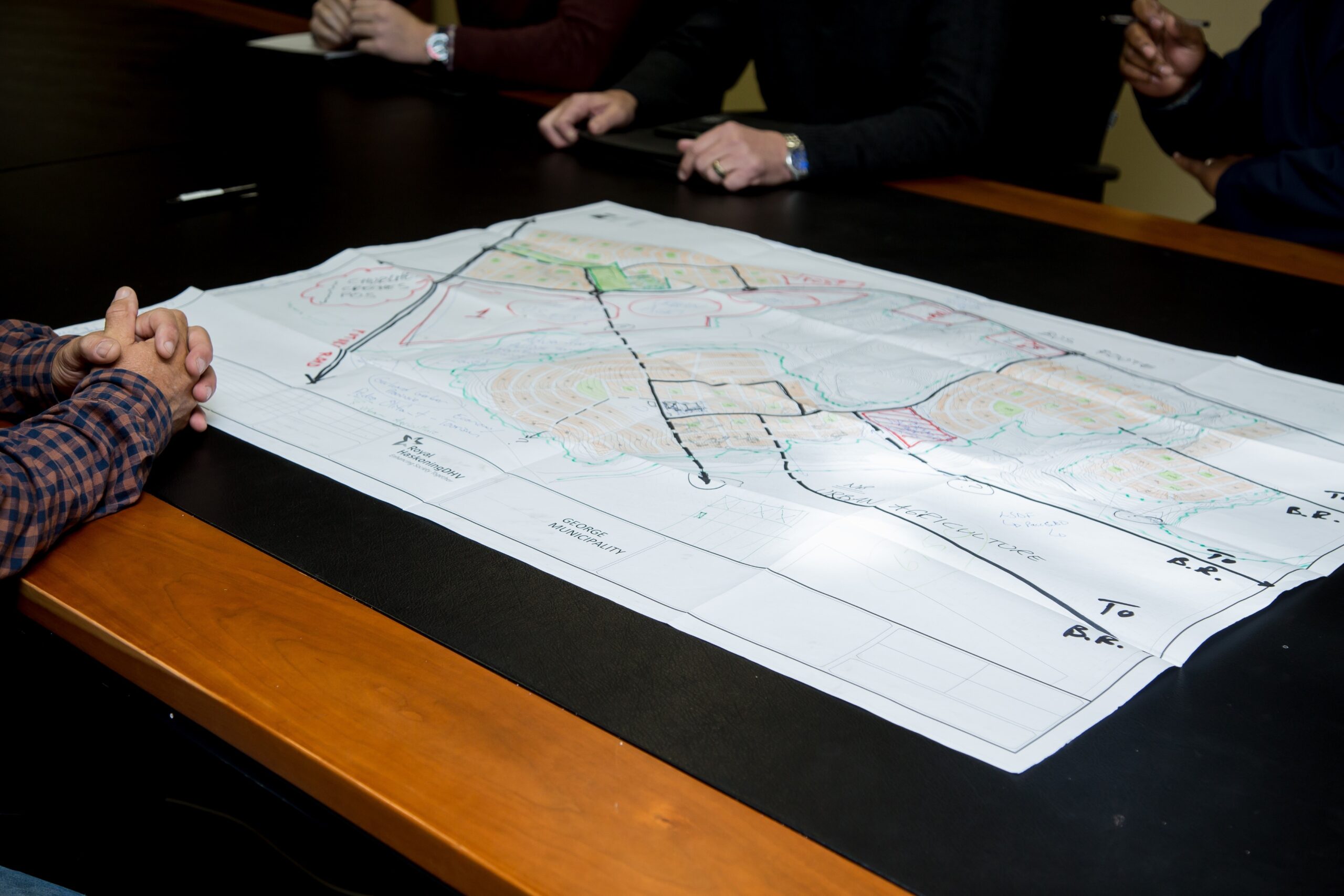
George Municipality has an obligation in terms of Section 152 of the South African Constitution to promote a safe and healthy environment and reminds all property owners and developers that building plan approval must be obtained before construction begins. This aligns with the requirements of the National Building Regulations and Building Standards Act, 1977 (Act 103 of 1977).
- Why Building Plan Approval Is Required
The National Building Regulations and Building Standards Act requires submission of building plans to and approval by the Municipality before any construction work commences.
Approval is necessary to ensure:
- Structural safety of the building;
- Compliance with zoning and building line requirements;
- Protection of neighbouring property and assets;
- Proper drainage and stormwater management;
- Compliance with health, ventilation, lighting and fire safety standards (SANS 10400);
- Controlled and lawful development within the municipal area.
Construction without approved plans renders the owner of the property liable as it may result in unsafe structures, legal disputes, additional costs, and enforcement action.
- How to Obtain Building Plan Approval
Step 1 – Prepare Building Plans
Building plans must be prepared in accordance with the National Building Regulations. Where required, a registered architectural professional must be appointed by the owner to prepare and submit the plans. Your appointed architect is your advisor and shares the obligation to ensure compliance of your development with the requirements of the National Building Regulations.
Step 2 – Submit Application
The completed application, together with required drawings and supporting documents as prescribed in the Act, must be submitted to the Building Control Section via the prescribed submission process.Step 3 – Municipal Assessment
The Municipality assesses the plans to ensure compliance with:
- The National Building Regulations;
- SANS 10400;
- The Zoning Scheme Bylaw; and
- Other applicable municipal by-laws and legislation (including environmental law and heritage legislation).
Step 4 – Notify of Commencement
In terms of Regulation A22 of the National Building Regulations, the owner must notify the Building Control Office before commencing construction. This serves to ensure that required inspections are carried out at the prescribed stages. Failure to request inspections may delay the issuing of a Certificate of Occupancy and incur additional costs toward certification of compliance with the prescribed codes and standards.
- Permissions
In terms of section 7(6) of the National Building Regulations, the local authority may grant provisional authorization to an applicant to commence or proceed with the erection of a building prior the approval of a building plan application.
This approval may be granted upon receipt of a written request of the applicant directed to the Manager Building Control and may be subjected to such conditions as the local authority may think fit.
In addition to the documents required for the standard building plan application, the following documents may be required for consideration of a request for commencement of construction:
- Land Surveyor Beacon and Placement certificates indicating the cadastral boundaries of the property as well as the placement of the buildings in relation to these boundaries.
- Structural Engineers rational assessment/report confirming the structural integrity of the “as-built” structures.
- Competent person’s rational assessment/report, confirming compliance in terms of the National Building Regulations of the “as-built” structure.
- Tariffs and Penalties
Building plan application fees are determined annually and approve by Council in accordance with the approved Tariff Policy. Where construction commences before plans are submitted and approved:
- The applicable application fee will include an additional tariff.
- This is not a fine, but an approved municipal tariff.
- The purpose of the additional tariff is to discourage unlawful commencement of construction.
- Reduced Fees and Waivers
The Municipality recognises that many households are affected by financial constraints. Therefore:
- In subsidised housing areas, or where the owner qualifies as indigent, application fees are reduced in accordance with Council policy.
- Verified indigent households may qualify for a waiver of the penalty tariff.
- Owners may approach the Building Control Office for guidance on how to apply for such relief.
Each case is assessed in accordance with its unique merits and guided by Council policy. Note that if acted on poor advice by your builder, architect, political leaders, friends or unauthorized officials to proceed within out approved building plans, this will not be regarded as sufficient merit for a waiver.
- Important Reminder
Owners and developers are strongly advised not to commence with construction prior to obtaining building plan approval.
Starting construction without approval compels the Municipality to act in accordance with the prescripts of the NBR and may result in:
- Stop-work orders;
- Compliance notices;
- Additional costs;
- Reporting of unscrupulous contractors and architects to their oversight bodies; and
- Delays in occupation.
Plan your project well in advance to allow for sufficient time for the preparation and approval of the building plans. Commence with the construction within 12 months from the date of approval to prevent lapsing of the approved plan.
- Legislation determines:
Whether property owner, citizen, employee of state, contractor or politician – we are all subjected to the legislation of our Country. With regards to construction activities, specific reference is made to:
- A25(9) of the National Building Regulations determines that – Where any building is being or has been erected and any contravention of these regulations other than those relating to matters referred to in sub-regulation (4) or (5) has been committed, the local authority shall serve a notice on the owner of such building.
- In terms of the Architectural Profession Act 44 of 2000, Architects are required in terms of rule 6.3 of their code of conduct to – comply with the National Building Regulations and Standards Act 103 of 1977, Town Planning Schemes, National Heritage Resources Act 25 of 1999 and any other built environment laws or any other applicable law governing the works.
- In Section 119. (1) of the Municipal Systems Act that – A councillor who attempts to influence the municipal manager or any other staff member or an agent of a municipality not to enforce an obligation in terms of this Act, any other applicable legislation or any by-law or a decision of the council of the municipality, is guilty of an offence and on conviction liable to a fine or to imprisonment for a period not exceeding two years.
The responsibility to ensure development on property conforms with safety standards starts with the property owner and the Municipality has an obligation to hold the owner accountable for their actions. Owners are encouraged to consult with the Building Control office before following advice that will result in non-compliance with the legislation of the Country and Municipal Bylaws. The George Municipality seeks to work with property owners to ensure their construction project remains a source of excitement and accomplishment and invite owners to visit us at our offices at 46 Market Street George or contact us at Email: jjlabuschagne@george.gov.za / ekoeberg@george.gov.za
Telephone: 044 801 9370